Photo: Koshiro K/Shutterstock.com
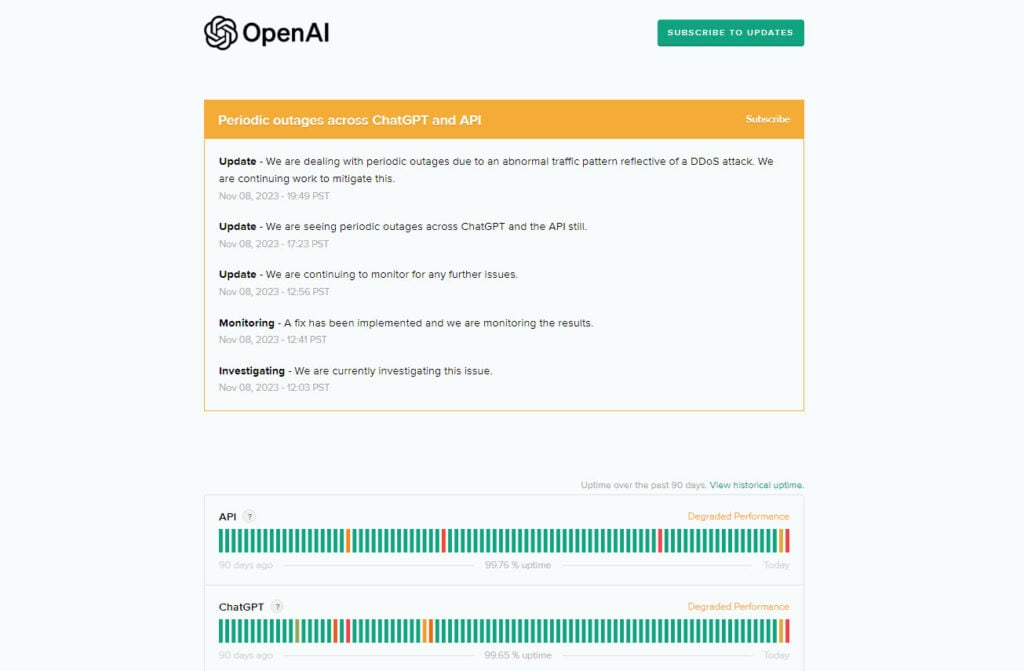
ChatGPT by OpenAI suffered a major outage due to a DDoS attack on 8th November. Anonymous Sudan and SkyNet claimed responsibility for the attack.
Users saw a “ChatGPT is at capacity right now” message when they tried to sign in or wrote prompts for answers.
OpenAI swiftly responded and acknowledged the issue on their status page. A subsequent announcement confirmed the implementation of a fix, with services gradually returning to normal at the time of writing this article.
“We are dealing with periodic outages due to an abnormal traffic pattern reflective of a DDoS attack. We are continuing work to mitigate this,” reported OpenAI’s status page.
OpenAI has still not confirmed the threat actors behind this attack and has maintained silence.
The cyberattacks followed the OpenAI DevDay conference, where OpenAI launched multiple products, including GPT-4 Turbo and custom GPTs.
CNBC reported that Claude 2 also suffered issues on Wednesday. Users witnessed a “Due to unexpected capacity constraints, Claude is unable to respond to your message.”
As per Cyberdaily.au, the attack was first reported by SkyNet on Telegram.
Anonymous Sudan too, on their Telegram channel, claimed responsibility for the DDoS attack on OpenAI, citing four reasons:
- OpenAI’s cooperation with the occupied state of Israel the CEO of OpenAI saying he’s willing to invest in Israel more, and his several meetings with Israeli officials like Netanyahu, according to Reuters.
- AI is now being used in the development of weapons and by intelligence agencies like Mossad, and Israel also employs AI to oppress the Palestinians further.
- OpenAI is an American company, and we still target any American company.
- ChatGPT has a general bias towards Israel and against Palestine, as it has been exposed on Twitter; in general, there’s a huge bias of the model towards some topics, which has to be fixed.
Along with that, the threat actor also targeted Cellcom, an Israeli telecommunication company. The hackers claim they have access to more than 180,000 Cellcom customer data.
A few months back, it was reported that Anonymous Sudan was backed by Russia. Hence, their attacks seemed to be more politically motivated.
In March, a Redis bug exposed data of OpenAI customers. However, the company said the data only affected 1.2% of total customers.
In the News: Threat actor farnetwork linked to five ransomware strains