If you’re an avid user of online chats, social media posts, or MMOs, you might have encountered the acronym NTY.
But few people know what it means and how to use it properly. In this article, we’ll explain the meaning, origin, and usage of NTY in online communication.
What is NTY?
NTY is not a common acronym and hence it is understandable why people have problems in using it. It stands for ‘No Thank You’ and can be used to decline an offer or a request by someone online politely.
As you can see NTY adds a ‘no’ in front of ‘thank you,’ which is an expression of gratitude in both online and offline conversations. It may look a bit straightforward and usually closes the conversation from your end.
Now a bit of a history lesson for you all. NTY is one of the earliest shorthand expressions and has been used since the early days of internet conversations. In those days, the mobile screens were small and people had to rely on quick and short words to pass on the message. When you head to the Urban Dictionary, you will find that the first use case of NTY was listed in 2005 by a user who goes by the name SquirrellyWrath. This demonstrates that the acronym has been used much before 2005.
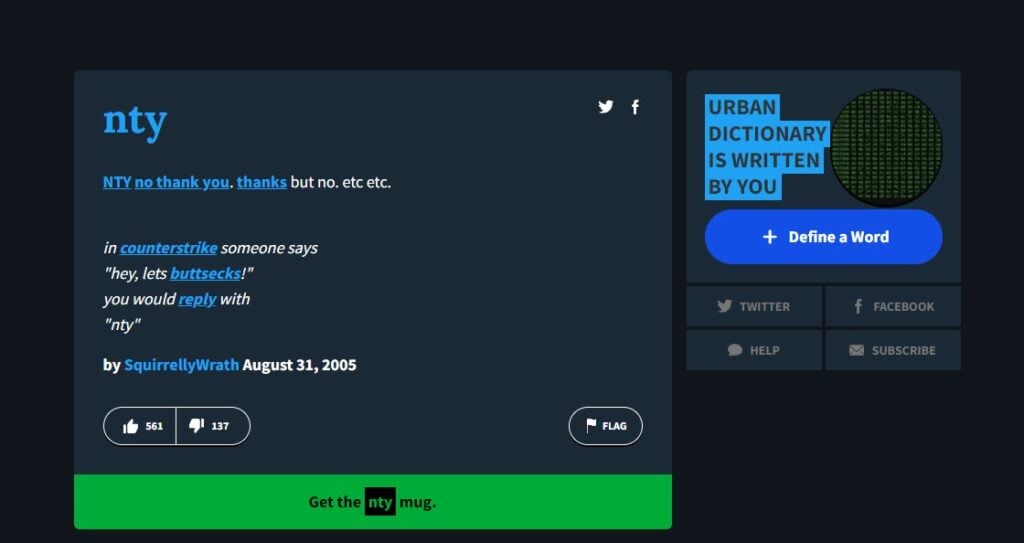
Let us take an example so that you can understand the acronym better. Suppose, you are playing an online game and you see a request by another team asking you to join their team or guild. In this case, you can reply with “NTY, I am cool” or “NTY, I am in another team.”
Other use cases of this acronym are as follows:
- Rejecting an invitation: If you got an offer to join an online meeting or received an invitation for a get-together, you can reply with “NTY, I am busy elsewhere.”
- Refusing a request: If someone asks you to do something online and you are unable to do it at the moment, you can say “NTY, I am doing something else.”
- Expressing objection: If your online friend asks for your advice or opinion on an issue and you disapprove of it, you can say “NTY, the other one looks better” or “NTY, that’s not how I think.”
- Blunt refusal: NTY works best for blunt refusal if you get unsolicited requests. For example, if a random stranger asks you whether you are interested in a product, you can simply say “NTY” and the conversation is over.
Also read: What does WRD mean on the internet?
How to use NTY?
You can use NTY both in uppercase or lowercase format online. In casual online conversations, the letter cases usually don’t matter much.
As we have explained earlier, some people may find the acronym to be cold and distant. So, you should always add a line or two after the acronym to convey your message clearly. However, for unsolicited messages, simply NTY will do.
Also, you should not use this acronym with your superiors at the workplace. In this case, you should say the full version along with the message.
Furthermore, keep in mind that this acronym does not suit well in many conversations. So, you can try other expressions such as NVM (Never Mind), NBD (No Big Deal), or NGL (Not Gonna Lie).
In conclusion, you can use NTY when you want to end the conversation quickly while simultaneously rejecting the request, offer, unsolicited messages, and invitations. However, take some precautions when using this acronym as it is a bit direct. Use the shorthand forms that we have listed above in place of NTY so as not to get yourself into embarrassing situations.
Also read: What is the meaning of MIA in texts?